REVIEW · EPHESUS TOURS
Private Full Day Ephesus Tour from Bodrum
Ephesus hits different when you start by a mountain shrine. This private day links Virgin Mary’s House peace with the scale of the Ephesus ruins, from the Library of Celsus to the Great Theatre. I also like that the tour runs with a comfort-first pace in a modern A/C Mercedes Vito, and that English guidance helps you connect the dots. One possible downside to plan for: entrance tickets and lunch are extra, and some departures include shopping stops where you may feel sales pressure.
You’re looking at a full sweep of the area, not just one photo stop. The guide is a licensed English speaker, you get pickup and drop-off from your hotel or cruise port, and you get guaranteed skip-the-line at the main sites. In a day that can run 6 to 8 hours, that saved time matters.
Just keep your expectations realistic about travel time. The drive is advertised at about 2 hours from Bodrum to Ephesus, but real-world timing can stretch with traffic and weather, depending on the day. That affects how much time you feel you have on the ground, especially if you’re racing a cruise re-boarding window.
In This Review
- Key points to know before you go
- From Bodrum to Ephesus: a long day that still feels organized
- Virgin Mary’s House on Bulbul Mountain: quiet faith on plain Roman stones
- Civic Ephesus: the State Agora and Odeion’s two roles
- Walking Curetes Street: Hadrian’s Temple, Domitian’s Temple, Hercules Gate
- Terrace Houses: how wealthy Roman families lived on Bulbul Mountain’s slope
- Celsus Library and the Great Theatre: Ephesus at postcard scale
- Basilica of St. John and the Artemis Temple ruins: spiritual layers over time
- Comfort, guiding style, and why names like Melahat, Selim, and Ulas keep coming up
- Shopping stops: a potential time sink and a buy/no-buy test
- Price and value: what $259 really covers, plus the add-ons you must budget
- Final verdict: should you book this Bodrum to Ephesus private day?
- FAQ
- What is the duration of the Private Full Day Ephesus Tour from Bodrum?
- Are hotel or cruise port pickups included?
- Is the tour in English?
- Are the entrance tickets included in the tour price?
- What transportation is included?
- Where do cruise passengers meet the tour for pickup?
Key points to know before you go
- Private, not group-bus touring means you get your own timing and your own guide attention.
- Skip-the-line promise reduces the most annoying time sink at major entrances.
- Virgin Mary House adds a calm break from heat, crowds, and Roman-stone overload.
- Ephesus highlights are spread smartly across civic, religious, and residential spaces.
- Bring cash for extras since Ephesus and Virgin Mary House admissions are separate, plus lunch.
- Expect potential shopping stops (rug or leather) and decide your buy/no-buy plan early.
From Bodrum to Ephesus: a long day that still feels organized
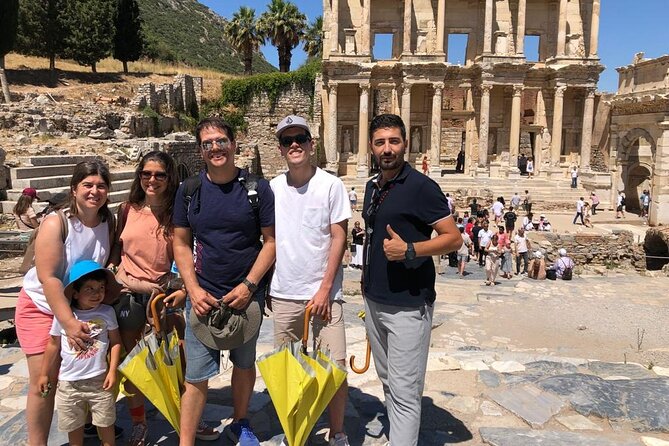
A day trip to Ephesus can feel like you’re spending half your vacation sitting in a vehicle. What helps here is the setup: pickup from your Bodrum hotel or the Bodrum cruise port, a full-day plan, and a comfortable A/C Mercedes Vito with a private driver.
The route is about 2 hours each way in the plan. On some days, that can be closer to 2 hours 25 minutes, and in one case it stretched toward 3 hours. I’d treat that as normal variance, not a surprise. If you’re on a cruise, your docking and re-boarding times drive the tightness, so you’ll want to be ready to move when your guide says move.
The tour duration is listed as about 6 to 8 hours. That range usually means some timing flexibility depending on the season and how long you spend at each stop. The guide pacing helps a lot, and the best examples from past guests highlight guides who didn’t rush and adapted for family needs, like helping an elderly traveler through the site.
More Ephesus Tours in Kusadasi
- FOR CRUISERS: Skip The Lines PRIVATE EPHESUS TOUR &On Time Return
★ 5.0 · 8,527 reviews - Top Choice For Cruisers: Ephesus, Mary’s House WITH TICKETS+LUNCH
★ 5.0 · 7,233 reviews - PRIVATE EPHESUS TOUR FOR CRUISERS: On-time Return and Skip-Line
★ 5.0 · 5,807 reviews
Virgin Mary’s House on Bulbul Mountain: quiet faith on plain Roman stones
The tour starts at Meryemana, the House of Virgin Mary, high on the Bulbul mountain above Ephesus. If you want a break from the typical hard-edged, sun-baked ruin slog, this stop is the palate cleanser.
What I like is the setting and the architecture. It’s described as a Roman-style structure built from stone, tucked into greenery. The story centers on the belief that Mary spent her last days here, with Saint John associated with the region. You’ll also learn about the later additions: a church built in the 4th century that combined her house and grave, including a space used as a chapel for Muslims.
In the practical sense, this stop also changes the tempo. You’re not just looking at carvings and columns, you’re walking in a quieter environment up on the hill. One review specifically mentioned people lighting candles or leaving personal prayers by a spring area near the site, so you might see that as part of the atmosphere.
Time wise, plan around 45 minutes. That’s enough to take it in without turning it into a long sit. If you want more quiet time, bring your own patience, because your guide still has the rest of Ephesus to cover.
Civic Ephesus: the State Agora and Odeion’s two roles
Once you move down into the ancient city area, Ephesus becomes less about temples only and more about how people lived and argued.
The State Agora is a great example. It wasn’t commerce-first. It was used for business and for government discussions. As you walk through the space, your guide can point out details from excavations, like graves found in the northeast corner and evidence of older uses including a necropolis period. There’s also a water reservoir at the corner, tied to the Pollio Aqueduct system that brought water into the city.
Then you shift to the Odeion, a smaller building shaped like a theatre. This one had a dual function: it served as a Bouleuterion for meetings of the senate-like group, and also worked as a concert hall for performances. It’s the kind of stop where a guide’s explanations matter because the building’s shape can look “just another theatre” until someone tells you how civic power operated through spaces like this.
These stops are short, about 15 minutes each. The upside is you get variety without feeling trapped in one area. The tradeoff is you’ll want to listen closely, since there’s not time for a slow museum-style reading at every stone.
Walking Curetes Street: Hadrian’s Temple, Domitian’s Temple, Hercules Gate
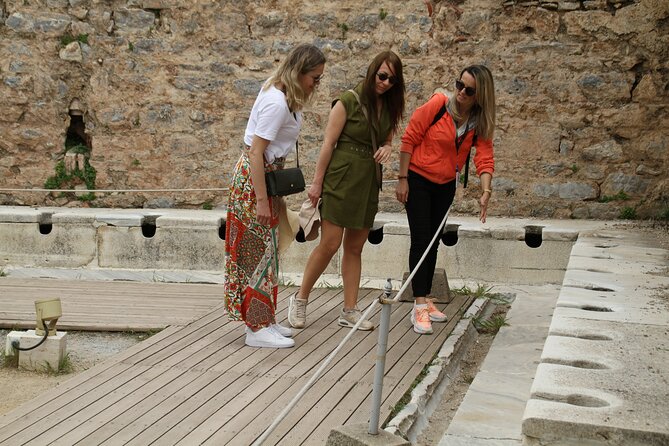
Ephesus really delivers when you’re on the main street spine and the buildings line up like chapters. This part of the route focuses on a cluster of impressive structures along Curetes Street.
Start with the Temple of Hadrian, one of the best-preserved looking structures there. The facade includes four Corinthian columns supporting a curved arch, and in the center is a relief tied to Tyche, goddess of victory. There are also inscriptions and pedestal bases for statues connected to emperors between 293 and 305 CE. Even if you don’t know the names, you’ll appreciate how the temple façade still shows the original power message.
Next is the Temple of Domitian, built on a wide terrace with vaulted foundations, and reached by stairs that are still visible. This is noted as the first emperor-dedicated structure in Ephesus, which means it’s tied to the moment when Rome’s prestige became local pride. There’s also mention of a U-shaped altar displayed in the Izmir Museum, so even when you’re not seeing everything in place, your guide can connect what’s missing to what survives elsewhere.
Then comes Hercules Gate, called that because of a relief of Hercules. It was relocated in the 4th century AD, while the relief itself is dated to the 2nd century AD. The guide can also explain the street design logic, like how the gate narrowed the entrance and helped keep the street more pedestrian in later periods.
Time is brief here, around 15 minutes per stop. I’d still treat this as a highlight zone. These structures are among the most recognizable Roman forms, and you’ll feel like you’re walking through the “showcase” portion of Ephesus rather than getting lost in smaller fragments.
More Ephesus visits:
- PRIVATE NO HIDDEN FEES Ephesus, Mary’s House Guided Tour /GRP OPT
★ 5.0 · 2,455 reviews - For Ship Guests:BEST SELLER EPHESUS PRIVATE TOUR & On Time Return
★ 5.0 · 2,029 reviews - ALL INCLUDED: Ephesus Ruins, Mary’s House Tour incl ENTRY TICKETS
★ 5.0 · 1,670 reviews - Ephesus Temple of Artemis and House of Mary Private Half Day Tour
★ 5.0 · 1,573 reviews
Terrace Houses: how wealthy Roman families lived on Bulbul Mountain’s slope
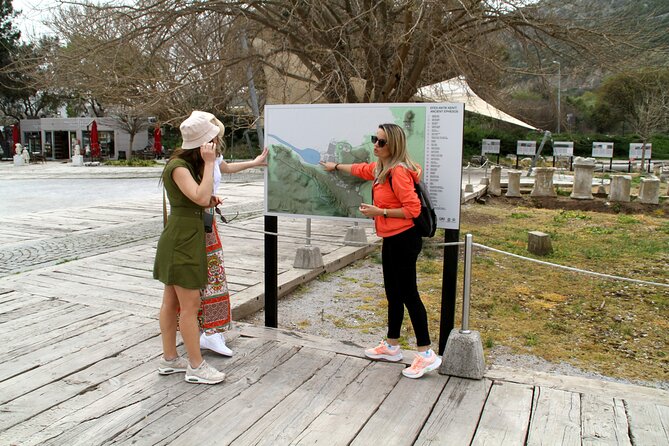
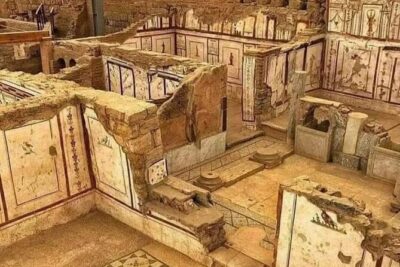
The Ephesus Terrace Houses are a different kind of wow. Instead of only big public monuments, you’re seeing the domestic world, the homes of wealthy Romans. They sit on the hill opposite the Hadrian Temple.
A detail I appreciate here is the city layout. The houses followed a Hippodamian plan, with roads running at right angles. That connects the scale of the city to the organization of daily life.
The site is described as having six residential units across three terraces. The oldest buildings date back to the 1st century BC and continued as residences until the 7th century AD. That long timeline is helpful because it stops you from thinking of Ephesus as one fixed moment in time.
You’ll also notice protective roofing over the remains, plus mosaics and frescoes that have been consolidated. Two houses are opened to the public as a museum. If you’ve ever wished archaeology felt more personal, this is the stop where it does. Even in short time, it gives you a sense of space, status, and family life instead of only power and worship.
Expect about 30 minutes here. It’s one of the best stops for “I get it now” moments, especially if your guide explains what you’re seeing as you look down from the slope.
Celsus Library and the Great Theatre: Ephesus at postcard scale
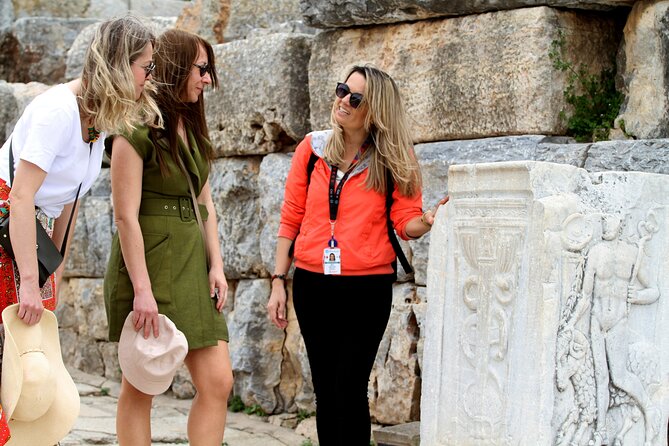
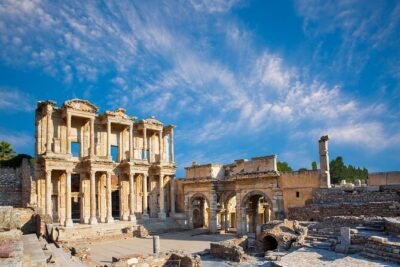
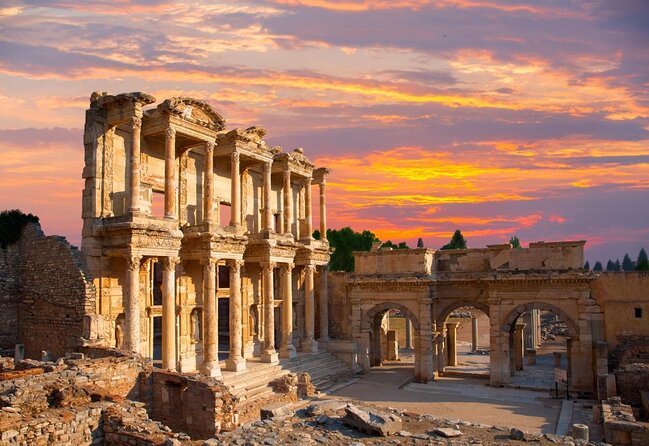
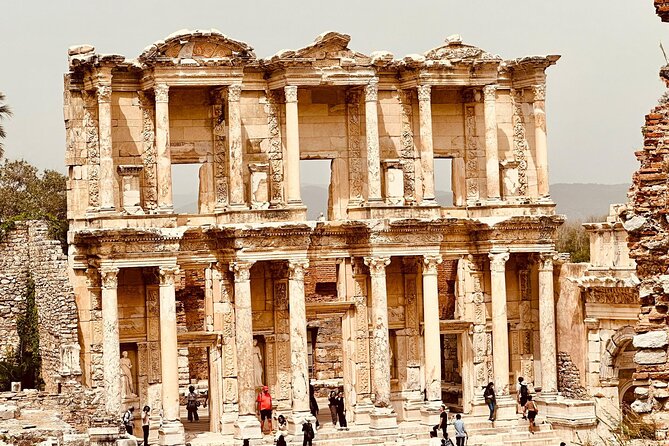
This is the pair most people come for, and it’s easy to see why. The Library of Celsus is one of the most beautiful structures in the city. It was built in 117 AD as a monumental tomb for Gaius Julius Celsus Polemaeanus, and his grave sits beneath the ground floor with Athena referenced in the design concept.
What’s interesting is how the library worked. Scrolls were kept in cupboards in wall niches, and there were double walls behind the bookcases to protect from extreme temperature and humidity. It’s the sort of detail that makes the building feel practical, not just decorative.
Then you move to the Ephesus Great Theatre, first constructed in the Hellenistic period and expanded in the Roman period into the style you see today. The theatre is described as the largest in Anatolia with a capacity of 25,000 seats, and you’ll get a sense of how serious entertainment was, from plays and concerts to religious, political, and philosophical discussions, plus gladiator and animal fights.
Time is about 15 minutes for each major stop. That’s not a full “sit in the shade and study” visit, so your best strategy is simple: look first, then let your guide explain. When you do it in that order, the facts land better.
One practical tip: if it’s hot, keep your water handy. The theatre and library areas can be sun heavy, and this tour does not slow down enough to pretend the weather won’t matter.
Basilica of St. John and the Artemis Temple ruins: spiritual layers over time
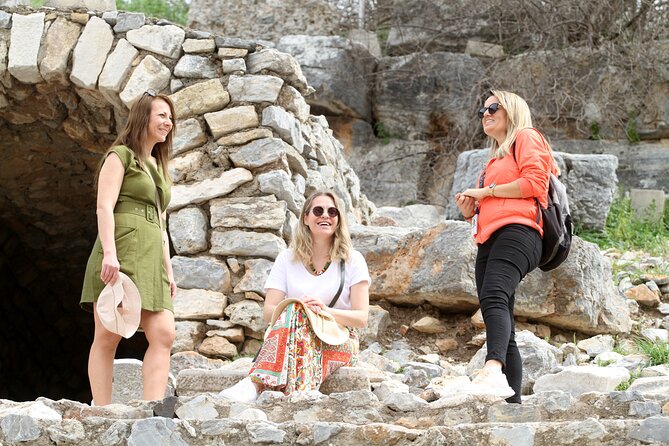
Ephesus is one of those places where religions stack on top of each other, and you can see it in how the sites are described.
The Basilica of St. John ties into tradition that the evangelist spent his last years in the region and was buried on the southern slope of Ayosolug Hill. A small chapel was built over the grave in the 4th century, then the church became a basilica during the Byzantine era under Emperor Justinian (527 to 565 AD). The story also references early Christian persecution in the region and links John’s writings to Ephesus and Revelation to Patmos.
Then you finish with the Temple of Artemis, known as one of the Seven Wonders. Today you see foundations only, since the original area turned into a swamp over the centuries. The ruins you can visit are Hellenistic foundations, and the most beautiful remaining pieces are in the British Museum.
Temple of Artemis is listed as a free stop for admission to the area you can access. That makes it a good closer because you often get a final “big concept” moment without additional ticket friction.
If you’re religious, this can feel meaningful. If you’re not, it still works because you understand the place as a long-lived cultural magnet.
Comfort, guiding style, and why names like Melahat, Selim, and Ulas keep coming up
A tour is only as good as how it moves. Here, the structure matters: pickup, a private driver, an English-speaking licensed guide, A/C transport, and skip-the-line for entrances.
From past experiences with different guides, the strong theme is clear communication and pacing. Several guides were singled out by name for being friendly, flexible, and proactive. For example, guests praised guides like Melahat for flexibility, Selim for history context, Nur for both personality and strong cultural explanations, and Ulas for excellent English and real storytelling energy. Others highlighted guides like Eylem, Tas, Salim, and Bano for tailoring the day to family needs or keeping the experience fun even in heavy heat.
The practical takeaway for you: if you like your day structured, you’ll likely appreciate a guide who knows how to keep the stops flowing and still answer questions. If you’re hoping for a highly detailed lecture on every stone, that can vary by guide. So it’s worth asking, in the moment, what you can skip and what you can slow down on.
Also, the tour says you need a moderate physical fitness level. That typically means walking between sites and up and down uneven ground, especially with the hill stops. If you’re bringing mobility help or you’re traveling with someone who struggles, tell your guide early so they can adjust the route and pacing.
Shopping stops: a potential time sink and a buy/no-buy test
One thing you should plan for is that some departures include stops tied to carpets and leather, and sales pressure can be part of the experience. This isn’t a small detail. It can change the feel of your day because you trade ancient stones for shop counters.
In one account, there was strong pressure to buy a rug, and the shopper felt the pressure did not stop after the sale. Another review mentioned a carpet factory stop and shopping additions. None of this is required viewing for the Ephesus story, so if you want to protect your time, go in with a clear plan.
My advice is simple:
- Decide your shopping boundary before you arrive. If you don’t want to buy, say so politely from the start.
- If you do buy, set expectations clearly and keep all paperwork. You want receipts, timelines, and delivery terms in writing.
- If you want more ancient time and less store time, ask your guide what can be adjusted within the day.
You booked this for Ephesus and the Virgin Mary House. Keep the day anchored there.
Price and value: what $259 really covers, plus the add-ons you must budget
The tour price is $259 per person, private, with pickup and drop-off, an A/C Mercedes Vito, a licensed English guide, parking fees, all taxes, and guaranteed skip-the-line access.
The big value lever is that skip-the-line promise and guided pacing help you use your limited time well. The second value lever is private transport, especially on a long, hot day. A large bus can be exhausting. A smaller vehicle helps you feel less like luggage.
Now the costs you still need to plan for:
- Ephesus Ancient City admission: €40 per person
- Virgin Mary House admission: €18 per person
- Lunch: about $15 per person, described as a local lunch
So while you’re paying a premium for a private day, you’re also paying for logistics that reduce stress. If you’d rather pay extra and not deal with the back-and-forth of tickets, transport, and crowded group pacing, this can make sense.
If you’re traveling as a strict budget shopper who doesn’t want any shopping stops, you might end up paying similarly after adding admissions and then feeling annoyed by extra time in shops. In that case, compare the cost of a self-planned day versus the value you personally place on comfort and skip-the-line access.
Final verdict: should you book this Bodrum to Ephesus private day?
I’d recommend booking if you want:
- A private day with English guidance and a comfortable ride
- Skip-the-line convenience at the main Ephesus entry points
- A day that covers both Roman public monuments and a spiritual stop at Meryemana
I’d think twice if:
- You are extremely sensitive to shopping pressure and want a zero-shop day
- Your schedule is razor-thin because the drive can run longer than the advertised estimate
- You prefer admission fully included in the upfront price, since major tickets and lunch are extra
If you do book, go in prepared with two tactics: bring extra spending for admissions and lunch, and set your shopping boundaries early. Do that, and you’ll get a full, well-paced tour day where the big moments, like the Library of Celsus and the Great Theatre, land right where they should.
FAQ
What is the duration of the Private Full Day Ephesus Tour from Bodrum?
It’s listed as approximately 6 to 8 hours.
Are hotel or cruise port pickups included?
Yes. Pickup and drop-off are included from Bodrum hotels and the cruise port.
Is the tour in English?
Yes, it includes an English-speaking professional licensed tour guide.
Are the entrance tickets included in the tour price?
No. Ephesus Ancient City admission (€40 per person) and the Virgin Mary House admission (€18 per person) are not included. Temple of Artemis is listed as free.
What transportation is included?
You get pickup and drop-off in a brand new A/C luxury Mercedes Vito with a private driver.
Where do cruise passengers meet the tour for pickup?
Cruise passengers meet at the exit gate of the immigration terminal of the Bodrum cruise port, with a board showing the OTTI Travel sign.
Newest Kusadasi reviews on the site
- FOR CRUISERS /Top Seller Ephesus Private Tour / On Time Return★ 5.0 · 21 reviews
- Private Tour : Biblical Ephesus Tour for Cruisers from Kusadasi ( Ephesus ) Port★ 5.0 · 55 reviews
- FOR CRUISERS: Best of Ephesus Private Tour (SKIP-THE-LINE & ON-TIME RETURN)★ 5.0 · 40 reviews
- Private Tour : Customized Ephesus Tour for Cruisers from Kusadasi Ephesus Port★ 5.0 · 16 reviews
- Small Group Ephesus and Sirince Day Tour from Kusadasi/Selcuk★ 5.0 · 23 reviews
- Pamukkale Tour From Selcuk★ 5.0 · 18 reviews
- Private Tour : Best Seller Ephesus Private Tour From Cruise Port★ 5.0 · 19 reviews
- FROM IZMIR Cruise Port: Ephesus and Mary’s House Private Tour★ 5.0 · 21 reviews
Ephesus Tours, compared.
FOR CRUISERS: Skip The Lines PRIVATE EPHESUS TOUR &On Time Return
Read our review →Top Choice For Cruisers: Ephesus, Mary’s House WITH TICKETS+LUNCH
Read our review →PRIVATE EPHESUS TOUR FOR CRUISERS: On-time Return and Skip-Line
Read our review →PRIVATE NO HIDDEN FEES Ephesus, Mary’s House Guided Tour /GRP OPT
Read our review →
For Ship Guests:BEST SELLER EPHESUS PRIVATE TOUR & On Time Return
Read our review →
ALL INCLUDED: Ephesus Ruins, Mary’s House Tour incl ENTRY TICKETS
Read our review →Ephesus Temple of Artemis and House of Mary Private Half Day Tour
Read our review →