REVIEW · KUSADASI TOURS
Priene, Miletus, and Didyma Day Tour from Kusadasi
Three ancient cities, one easy minibus day.
I love the small-group setup, max 14 people, because it keeps the ruins from feeling like an assembly line. I also like that you travel with an art historian who helps turn the stones into stories you can actually picture.
One thing to double-check before you go is the entrance-fee mix. The tour highlights say entrance fees are included, but the details you’ll see also list entrance fees as not included, and Priene’s admission is marked as not included in the site-by-site notes.
You’ll start with hotel pickup around 9:00 am, spend roughly 8 hours touring, and end with drop-off back at your hotel. Expect a long, rewarding day that focuses on the Ionian coast’s big names, minus the mega-crowd energy of nearby Ephesus.
In This Review
- Key highlights worth getting excited about
- Why this Priene, Miletus, and Didyma tour is a smart Kusadasi choice
- Small-group minibus logistics: what “easy” looks like here
- Didyma’s Temple of Apollo: the oracle, the architecture, and the big views
- Miletus Antik Kenti: Ionian power, a port-city mindset, and theater time
- Priene Antik Kenti: Athena on the hill and a theater with real character
- Buffet lunch, guide pacing, and what to budget beyond the tour
- Who should book this Priene, Miletus, and Didyma day trip
- Quick reality check on price and value
- Should you book this Priene, Miletus, and Didyma tour?
- FAQ
- What time does the tour start and how long is it?
- Is hotel pickup and drop-off included?
- How many people are in the group?
- Is lunch included, and can I get a vegetarian option?
- Are entrance fees included?
- What’s included in the tour basics?
Key highlights worth getting excited about
- Three Ionian cities in one day, so you connect the dots between worship, port power, and city life
- Didyma’s Apollo sanctuary, including the Temple of Apollo area and dramatic Greco-Roman architecture
- Miletus stops that feel like a guided syllabus, from theater and agoras to harbor monuments and forts
- Priene’s theater and hilltop temple, with stand-out details like the front-row royal-style seats
- Hotel pickup and drop-off from Kusadasi and Selçuk area hotels, plus a port pickup option
- Buffet lunch included, with a vegetarian option if you request it
Why this Priene, Miletus, and Didyma tour is a smart Kusadasi choice
This is one of those tours that saves your time without turning your day into a speed-run. You’re not just seeing famous ruins, you’re moving along the Ionian coastline’s storyline, from sacred questions at Didyma to city power at Miletus, then to Priene’s carefully planned layout.
The small group matters. With a minibus and a maximum of 14 travelers, you can ask questions without shouting across a bus. That also helps the guide tailor pacing, especially when a site is busy or you want a moment to look longer at a detail.
Value-wise, you’re paying about $216.74 per person for a full-day package: pickup, transport, an art historian guide, and lunch. Drinks are not included, but if you plan on buying water on your own anyway, this still tends to feel fair compared with doing three sites separately and trying to line up timing.
Other Kusadasi outings to compare
- FOR CRUISERS: Skip The Lines PRIVATE EPHESUS TOUR &On Time Return
★ 5.0 · 8,527 reviews - Top Choice For Cruisers: Ephesus, Mary’s House WITH TICKETS+LUNCH
★ 5.0 · 7,233 reviews - PRIVATE EPHESUS TOUR FOR CRUISERS: On-time Return and Skip-Line
★ 5.0 · 5,807 reviews
Small-group minibus logistics: what “easy” looks like here
The day starts at 9:00 am, with pickup from all hotels in the Kusadasi area and from the port. If you’re staying in the Selçuk area, you’ll also get pickup there, then the minibus gets you moving toward the ancient sites.
Mobile tickets are included, which usually means you are not stuck hunting paper passes. Confirmation is sent within 48 hours of booking, subject to availability, so you’ll want to book with enough lead time if your schedule is tight.
One practical note: this is a full-day drive and site loop, so you’ll want to treat it like a day excursion, not a quick stroll. Ruins take time, and the tour plans real time at key stops, including longer time slots for Didyma and Miletus.
Didyma’s Temple of Apollo: the oracle, the architecture, and the big views
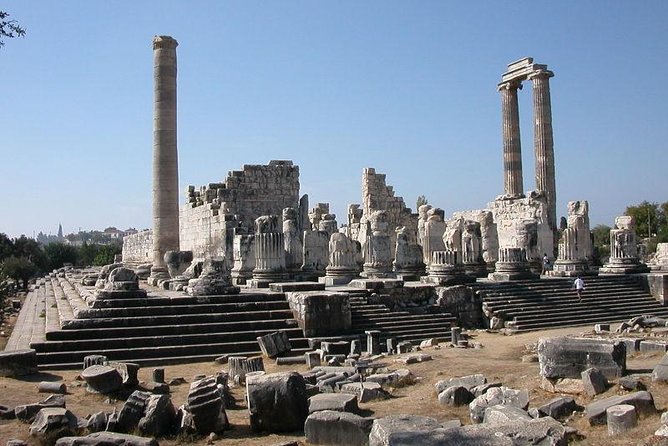
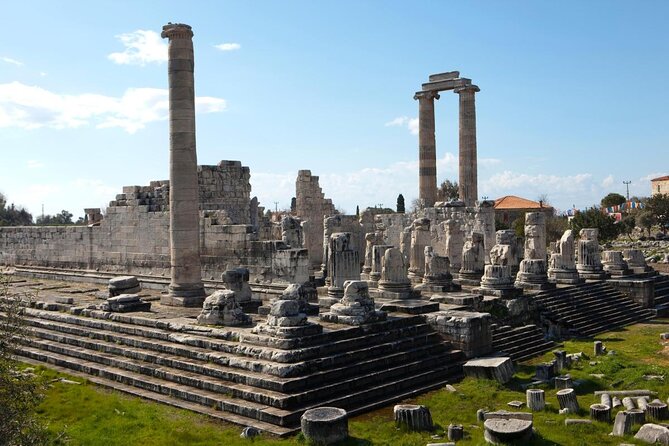
Didyma is the kind of place that feels larger than its current ruins. In antiquity, it was known across the Mediterranean as the site tied to Apollo and his oracle, and it was also a meeting point connected with Zeus and Leto, the mythic parents of Apollo and Artemis.
You’ll explore what remains of the Temple of Apollo’s sanctuary complex, with a focus on the structures and how they sit in the landscape. The details here matter. The earlier Greek temple built in the late 8th century BCE lies beneath later construction, so you’re effectively looking at layers, not just one “finished” monument.
The guide-led approach makes a difference at Didyma because the site is about symbolism as much as stone. You’ll hear about Didyma as a sanctuary connected to Miletus by a Sacred Way, meaning pilgrims traveled in search of answers to their questions. When you hear that, the site stops being just a photo stop and becomes a destination with purpose.
What I like about this stop is how much architecture you actually get to see in one visit. The area features dramatic Greco-Roman period remains, including the ruined Temple of Apollo and the striking stepped base. You’ll also see a stone medusa’s head and rows of white columns, plus viewpoints over the surrounding area.
If you’re the type who enjoys details like iconography and building phases, Didyma will feel especially satisfying.
Miletus Antik Kenti: Ionian power, a port-city mindset, and theater time
Miletus is where the tour shifts from sacred pilgrimage to civic and economic power. This hillside city once controlled a major port on the Maeander River, and it had a reach that stretched across the Mediterranean, the Black Sea, and Sea of Marmara.
The way you learn about Miletus is part of the value. You’ll connect the city to the Ionian Confederation, then to the practical stuff people built and used, like harbors and public architecture. There’s also an emphasis on early Greek coins minted in Miletus, which is a great reminder that history is not only temples and myths, it is also trade and everyday systems.
The stop itself includes a run of notable sectors and monuments. You’ll see the theater, a Byzantine fortress, harbor monuments, and the Delphinium. You’ll also cover the South Agora and the Baths of Faustina, then move into other visible layers like a mosque of Ilyas Bey and a caravansaray.
This is a longer stop, about 3 hours, so you get time to slow down. That matters because Miletus can feel “bigger than it looks” once you’re on-site and you start spotting the different building areas.
One consideration: if your main goal is one single must-see monument, Miletus might feel like multiple stops at once. But if you like understanding how a city functioned, that same variety becomes the point.
Same part of the country, a different kind of day:
- PRIVATE NO HIDDEN FEES Ephesus, Mary’s House Guided Tour /GRP OPT
★ 5.0 · 2,455 reviews - For Ship Guests:BEST SELLER EPHESUS PRIVATE TOUR & On Time Return
★ 5.0 · 2,029 reviews - ALL INCLUDED: Ephesus Ruins, Mary’s House Tour incl ENTRY TICKETS
★ 5.0 · 1,670 reviews - Ephesus Temple of Artemis and House of Mary Private Half Day Tour
★ 5.0 · 1,573 reviews
Priene Antik Kenti: Athena on the hill and a theater with real character
Priene is the third leg of the day, and it brings the tour a different flavor. This ancient city was important in the Byzantine era, and it sits between Ephesus to the south and Miletus to the north, which makes it a nice capstone to the route.
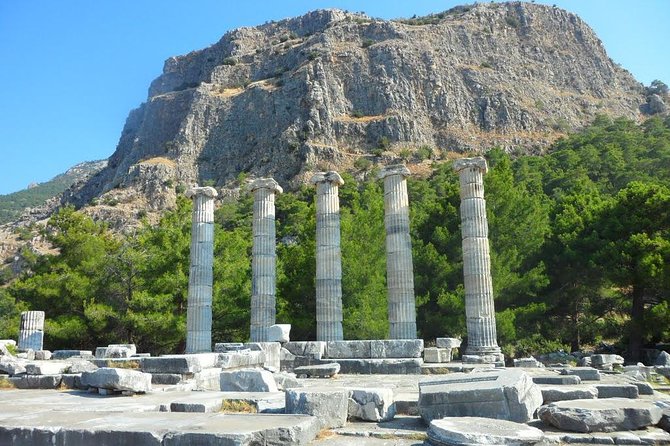
The standout is the hilltop Temple of Athena. Even without obsessing over architectural jargon, you’ll likely feel how the location was chosen for visibility and meaning. It’s one of those sites where the “where” helps explain the “why.”
Then there’s Priene’s theater, which is a highlight for anyone who likes performance spaces and acoustics. The front row has five king chairs, and the theater could seat about 6,500 people. You’ll also get a fun fact that the theater is described as the only one not renewed by the Romans, which gives it a special identity in the Greek world.
Priene gets about 1 hour in the plan. That’s not a lot, but it can be enough if the guide keeps the focus. My advice: if you want maximum time here, keep your expectations realistic. This is a “key sites” visit, not a full day of wandering.
One of the most interesting details connected to Priene is how advanced daily life was described. The city is noted for having houses where a high share of citizens had their own bathrooms and toilets, something that feels surprisingly modern when you stop and think about the era.
Buffet lunch, guide pacing, and what to budget beyond the tour
Lunch is included as a buffet, which is one of the simplest ways a tour becomes easier. You don’t spend the day searching for food between ruins, and you can usually eat without burning extra time.
Drinks are not included, so plan on water or other beverages being an extra cost. Also remember that entrance fees can be a confusing line item here. The highlights say entrance fees are included, but the details also list entrance fees as not included, and Priene’s admission is marked as not included. Before you pay on-site, confirm what you will and will not need to cover.
One more value point: the guide approach can shape your entire experience. In multiple accounts of this tour, guides named Gul, Mehmet, and Melike are praised for being personable and for sharing lots of useful information. That human factor matters. A good day tour does not just show you where things are, it teaches you how to look.
Also, the tour description notes that the Ionian landscape includes views of cotton plantations stretching toward the Aegean. If your timing hits good daylight, that drive scenery can add a calming rhythm between sites.
Who should book this Priene, Miletus, and Didyma day trip
I’d book this if you want an alternative to the Ephesus crowds, but still crave major Ancient Greek and Greco-Roman sites. It’s also a strong fit if you enjoy learning the logic behind civilizations, not just checking monuments off a list.
This tour is ideal for couples, solo travelers, and small groups who like structured pacing. The maximum of 14 travelers keeps it friendly, and the minibus pickup and drop-off makes it easier than arranging individual transport.
If you are traveling with mobility limitations or you want minimal walking, you should ask the operator how much walking each stop involves. The provided information does not spell out step counts or accessibility details, so it’s worth checking directly.
It also suits art-and-architecture lovers. The day is built around theaters, temples, agoras, and layered building styles, with Didyma’s Apollo sanctuary doing a lot of the heavy lifting for architecture.
Quick reality check on price and value
At $216.74 per person for about 8 hours, you are paying for three things at once: transport, a guided educational experience, and a built-in lunch plan. Hotel pickup and drop-off also add real value, especially if you do not want to figure out how to get between sites on your own.
The only budget caveat is entrance fees and drinks. With the conflicting notes about entrance fees, I strongly recommend you confirm the exact inclusions for your ticket. Once you do that, the price can feel very reasonable for a full guided day across three major sites.
Should you book this Priene, Miletus, and Didyma tour?
If your goal is to see the Ionian triangle of Priene, Miletus, and Didyma in one smooth day with an art historian, I think this is a solid choice. The small group cap, included lunch, and long focus at Didyma and Miletus make it feel purposeful rather than rushed.
I would only hesitate if you hate uncertainty around entrance fees or you prefer free-form touring with lots of extra time at each ruin. If you’re flexible and you like being guided, this is the kind of day trip that leaves you with more than photos, it leaves you with a mental map of how the ancient coast worked.
FAQ
What time does the tour start and how long is it?
The tour start time is 9:00 am, and the duration is about 8 hours.
Is hotel pickup and drop-off included?
Yes. Pickup and drop-off are included, with pickup from hotels and from the port in Kusadasi.
How many people are in the group?
The tour has a maximum of 14 travelers.
Is lunch included, and can I get a vegetarian option?
Lunch is included as a buffet, and a vegetarian option is available if you request it at booking.
Are entrance fees included?
This is listed in a couple of different ways. The highlights say all entrance fees are included, but the details also list entrance fees as not included, and Priene admission is marked as not included in the site notes. I recommend confirming what you personally need to pay.
What’s included in the tour basics?
You get a professional art historian guide, lunch, hotel pickup and drop-off, transport, and a mobile ticket. The tour is offered in English.
Newest Kusadasi reviews on the site
- FOR CRUISERS /Top Seller Ephesus Private Tour / On Time Return★ 5.0 · 21 reviews
- Private Tour : Biblical Ephesus Tour for Cruisers from Kusadasi ( Ephesus ) Port★ 5.0 · 55 reviews
- FOR CRUISERS: Best of Ephesus Private Tour (SKIP-THE-LINE & ON-TIME RETURN)★ 5.0 · 40 reviews
- Private Tour : Customized Ephesus Tour for Cruisers from Kusadasi Ephesus Port★ 5.0 · 16 reviews
- Small Group Ephesus and Sirince Day Tour from Kusadasi/Selcuk★ 5.0 · 23 reviews
- Pamukkale Tour From Selcuk★ 5.0 · 18 reviews
- Private Tour : Best Seller Ephesus Private Tour From Cruise Port★ 5.0 · 19 reviews
- FROM IZMIR Cruise Port: Ephesus and Mary’s House Private Tour★ 5.0 · 21 reviews
Kusadasi Tours, compared.
FOR CRUISERS: Skip The Lines PRIVATE EPHESUS TOUR &On Time Return
Read our review →Top Choice For Cruisers: Ephesus, Mary’s House WITH TICKETS+LUNCH
Read our review →PRIVATE EPHESUS TOUR FOR CRUISERS: On-time Return and Skip-Line
Read our review →PRIVATE NO HIDDEN FEES Ephesus, Mary’s House Guided Tour /GRP OPT
Read our review →
For Ship Guests:BEST SELLER EPHESUS PRIVATE TOUR & On Time Return
Read our review →
ALL INCLUDED: Ephesus Ruins, Mary’s House Tour incl ENTRY TICKETS
Read our review →Ephesus Temple of Artemis and House of Mary Private Half Day Tour
Read our review →